 |
| And here's what a savings of six cents per bottle looks like! |
Saturday, February 14, 2015
Once a cooler, now a mash/lauter tun
The next step on one's journey as a homebrewer seems like it could go to either all grain brewing, temperature controlled fermentation, or kegging. Kegging seems like it's mostly about convenience instead of economy (plus I kind of like bottles - easier to share and transport), and temperature control is a little more of an investment. After looking at prices on Northern Brewer, all grain brewing seems to cost ~$3 less for a batch than extract, so after brewing 18 times, it'll be like I've made money! But you also have a lot more options with what kinds and quantities of malts you can use, and I assume that finding a recipe and buying the grain will save even more money.

Thursday, February 5, 2015
Long Term Lambic and Chocolate Milk Stout
I brewed a lambic on January 18, 2015 and a milk stout on January 29, 2015, both from extract.
 |
| Here's me brewing in the garage. It was balls cold. |
Friday, November 28, 2014
Dubbel Brewday 11/23
I needed a cider version 2 (Louisburg; pasteurized but no sorbates, so the yeast should love it) and to knock out one of those kits I had. I settled on brewing Northern Brewer's La Petite Orange.
 |
| Here's the spread: Malt extract, Wyeast smack pack of 1214 Belgian Abbey, specialty grains, soft candi sugar, worksheet. |
Monday, September 1, 2014
First Hop Harvest
Three hop rhizomes were purchased in back in April and planted in early May: two Cascades and a Centennial. One failed to come up and one I think was on its way up but got dug up or died or something, so I only had one Cascade make it:
 |
| The single brave Cascade, climbing up a line on May 31st. Tomatoes in the foreground. |
Sunday, February 9, 2014
Bottling, Bottling, and Dry Hopping
Multiple topics here: on Feb 5, I bottled the robust porter and the cider. Then on Feb 9, I dry hopped the Kansas City Pale Ale and racked it to secondary (even though it's not necessary and sometimes not worth the risk even you dry hop or add fruit or things - discussion and more discussion).
 |
| Pale ale being siphoned into the carboy for secondary fermentation. |
Saturday, February 1, 2014
Robust Porter Update
This is an update to the Robust Porter I brewed on January 11.
Monday, January 27, 2014
Brewday January 26, 2014
The Plan:
Brew a "Kansas City Pale Ale" kit from Bacchus and Barleycorn.
Brew a "Kansas City Pale Ale" kit from Bacchus and Barleycorn.
Unlike last time, this was a full boil. Brewing happened outdoors (hurray for sixty degree January days) on a propane turkey fryer. I think I need one. And a giant kettle with a valve and thermometer built in.
In the glass: Sierra Nevada "Ruthless Rye" and New Belgium's not-as-good-as-Dig spring seasonal "Spring Blonde".
 |
| Large kettle on a propane turkey fryer, water and an immersion chiller in the background. Frigid winter hose water cools the hot wort down super fast. |
The Problems:
I don't know if there were any problems on the brewing side, but cool color tone croquet team definitely had some issues.
I don't know if there were any problems on the brewing side, but cool color tone croquet team definitely had some issues.
 |
| Blue/Black/Green getting utterly crushed Red/Yellow/Orange. |
There was one issue that I was worried about going in, though. I just purchased a refractometer, so I got to measure brix, which is a proxy for specific gravity. It's more or less 1/4th of the specific gravity, but that relationship breaks down at higher specific gravities. My refractometer measured 15.2 percent brix, which matched up nicely with the 60 points that the hydrometer measured. The best part about that is that the refractometer only takes a couple of drops instead of the entire test jar for the hydrometer.
Hopefully not a problem: we saved the final hops (1/2 oz of East Kent Golding hops) and are going to add them when we go to secondary.
I guess we also need to keep track of temperature when we pitch. I've heard that makes a difference. I think this might have been 76 degrees.
| Temperature since pitching the yeast. I don't know if this will update automatically as I add more info to the plot. Note: it does. I clicked "Publish chart" - "Interactive chart" - copy/pasted the java script into the HTML of the page. |
The Results:
OG: 1.055 (target)
OG: 1.060 (actual)
FG: 1.016 (target)
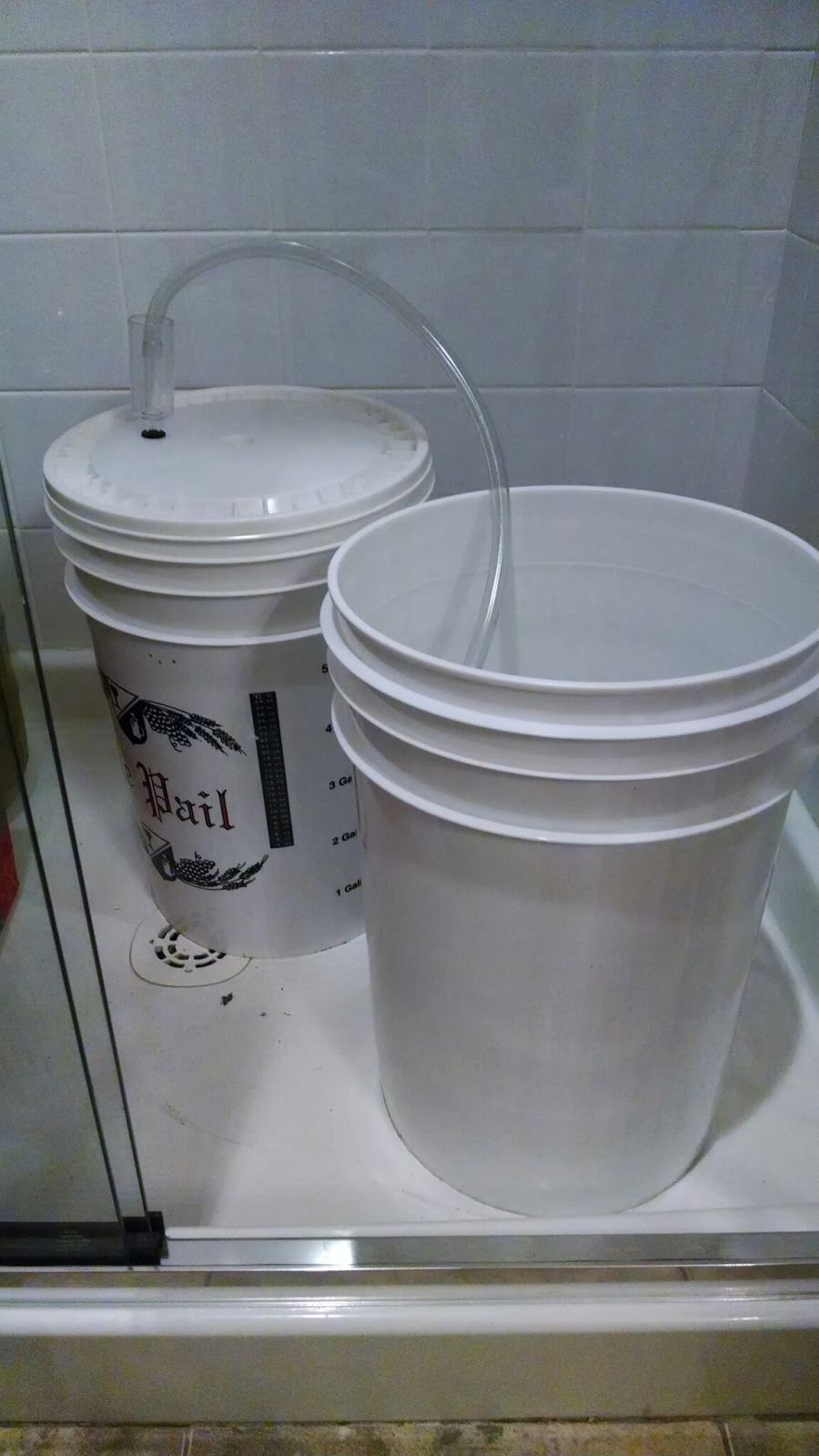
Fermenting in a 6+ gallon ale pail with blowoff tube installed.
 |
| It's boiling furiously, but you can't hear it because it is simply a picture. I should have signed up for Vine. |
Plans for the future involve some small batches of all grain (refractometer will help with this), growing hops, making a counterflow wort chiller, figure out some sort of basic temperature control, etc.
Subscribe to:
Posts (Atom)